Goddess Kaveri

GODDESS KAVERI

Kaveramma: The Sacred Lifeblood of South India

She is the Divine Mother. She is the Ganga of the South.

The eternal river, revered as Goddess Kaveri, flows as a pulsating stream of grace from the sacred Brahmagiri Hills at Talakaveri to the Bay of Bengal, traversing 800 kilometers through Karnataka and Tamil Nadu, sustaining millions and sanctifying all who seek her divine blessings.

🕉️ Today's Divine Blessing 🕉️

"Gaṅge ca Yamune caiva, Godāvari Sarasvatī. Narmade Sindhu Kāverī, jale 'smin sannidhiṃ kuru."

O Ganga, O Yamuna, and indeed, O Godavari, O Saraswati. O Narmada, O Sindhu, O Kaveri, may you all be present in this water.

The Sacred Grace of Goddess Kaveri: The Eternal River

In the cool mists of the Brahmagiri Hills, high in the green heart of Kodagu (Coorg), the sacred River Kaveri is born at Talakaveri, the holy birthplace that glows with faith and hope. She is more than a geographic feature; she is a pulsating stream of grace revered as Goddess Kaveri. Just as the Ganges is revered in the north, Kaveri is the flowing heart of the South, bringing life, purity, and prosperity. She is lovingly called “Ponni” or the “Golden One” by poets and devotees alike.

For the proud Kodava community, Kaveri is the Kuladevi (Clan Goddess), the eternal mother whose blessings shape every field and festival. No other river flows so deeply through the soul of a people. The Kodava people see themselves as “Kaveri’s Children” (Kaveramma), bound forever to her waters, her myths, and her maternal spirit.
She is the Divine Mother. She is the Ganga of the South.

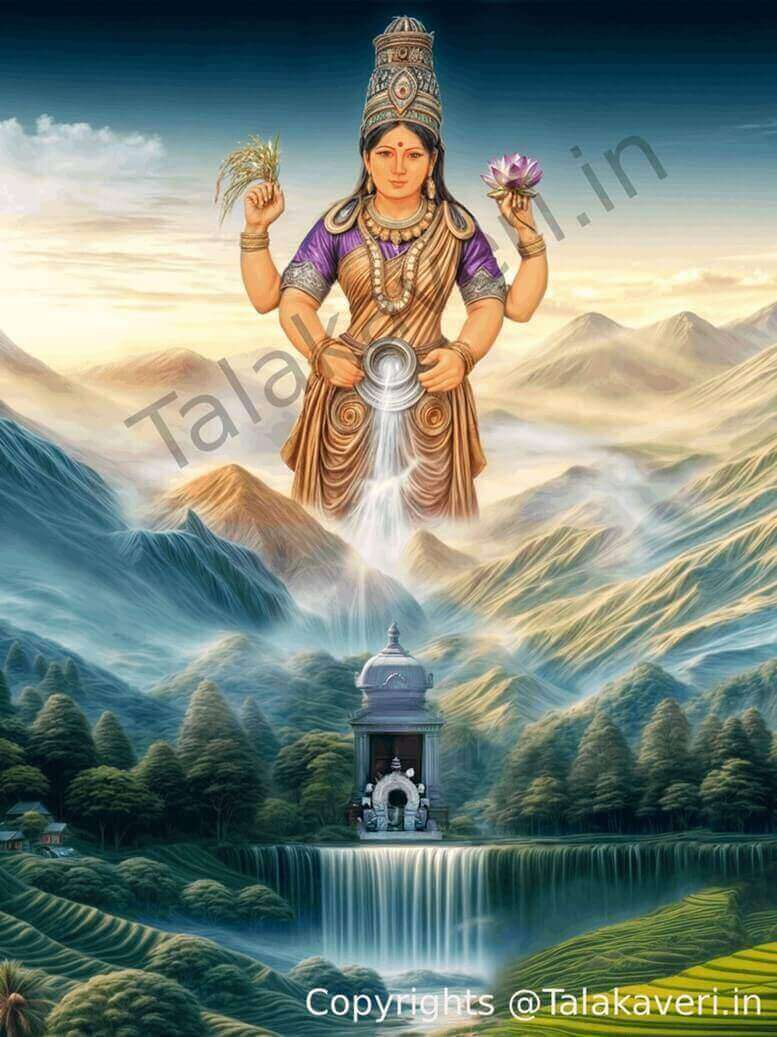
The Goddess in Sacred Form

The Goddess stands poised, symbolizing the eternal river's flow and radiating abundance. In her graceful hands, she bestows her divine gifts:

  • The Kamandalu (Water Pot): The ultimate symbol of her origin. It represents the sacred, celestial vessel from which the river first sprang forth at Talakaveri, confirming her divine source as a manifestation of a higher celestial power, sealed with the prayers of sages.
  • The Paddy (Dhaanya): These sheaves of rice paddy signify the abundance that made the Kaveri Delta the 'Rice Bowl of South India'—the agricultural heartland that has nourished civilizations for millennia.
  • The Lotus (Padma): Symbol of purity and spiritual ascent. Beyond purity, the lotus symbolizes the emergence of enlightenment and the promise of salvation (moksha) from the earthly realm.
  • Flowing Water: From her hand, the river springs eternal, a gentle touch that heals, nourishes, and never ceases.

To stand before her image is to receive a silent blessing; to see her smile in every drop of water, on every green hill of Kodagu.

The Seven Sacred Rivers: Sapta Nadi

Goddess Kaveri is formally recognized in Hindu theology as one of the Sapta Nadi, the seven primary holy rivers of India. Her inclusion validates her status as a national deity and a source of profound spiritual power. These seven rivers are invoked in rituals for the purpose of universal purification and spiritual cleansing (tirtham).

Gaṅge ca Yamune caiva, Godāvari Sarasvatī. Narmade Sindhu Kāverī, jale 'smin sannidhiṃ kuru.
(O Ganga, O Yamuna, and indeed, O Godavari, O Saraswati. O Narmada, O Sindhu, O Kaveri, may you all be present in this water.)

The Eternal Lifeline: Kaveri's Embodiment

Kaveri’s glorious journey stretches over 800 km, blessing the fields of Karnataka and Tamil Nadu, before merging into the eternal sea. She is the sustaining mother of millions and the embodiment of:

  • Sustenance (The Economic Lifeline): Kaveri is an economic force, responsible for transforming vast arid plains into fertile fields. She is a major source of hydroelectric power that sustains modern life and feeds millions.
  • Sanctity (The Purifying Theertham): Taking a dip in her waters is a profound act of faith and a celebrated sacred pilgrimage (theertham). It is believed to cleanse devotees of all sins and grant religious merit (punya) equivalent to bathing in the Ganges.
  • Spirituality (The Tri-Ranga Kshetrams): Her path is defined by centers of deep devotion. Along her course lie the revered Tri-Ranga Kshetrams—three magnificent, primary temples dedicated to Lord Vishnu, all uniquely situated on islands formed by her currents.
  • Literary & Historical Title: Referred to in ancient Tamil texts as 'Ponni' (The Golden One), she signifies the wealth, golden harvest, and prosperity that allowed mighty empires like the Cholas to flourish along her banks for centuries.

Rituals of Devotion: Kaveri Sankramana

The Kodava people's deepest stories recount how, when Kaveri wished to leave Kodagu, she was moved by their love and vowed to return every year. Thus, every year, during the joyous festival of Kaveri Sankramana, the goddess is ritually welcomed home.

  • Celebration: The Kodava homes glow with lamps and devotion. Offerings of grain, cucumber, and coconut, lovingly wrapped and adorned, become sacred symbols of the goddess herself. With each ritual, the Kodava honor Kaveri as their guardian, their nurturer, and the bringer of perpetual prosperity.
  • Kanni Puje Ceremony: On the day after Kaveri’s holy emergence (Theerthodbhava), every Kodava home celebrates with Kanni Puje, a beautiful ceremony performed by married women in new saris. They craft a tiny altar of coconut or cucumber, symbolizing the goddess, wrap it in red, and honor her with lamp, flowers, rice, glass bangles, and areca nuts.
  • Sacred Feast: A purely vegetarian feast of dosa, pumpkin curry, and payasa is offered in loving respect for their mother river.
  • Immersion: All offerings are finally brought to the riverbank and immersed in the sacred flow, united with the goddess as prayers and gratitude drift downstream, blessing communities for another year.

Poetic Homage: The Golden One

The Universal Ode (For All Devotees)

“Hail, Kaveri!
Crowned with blossoms,
Your waters dance like jewels,
Flowing gently through lands blessed by your touch.
You are the mother, the giver,
Golden river, life’s eternal pulse.”

Devotional Prayer (The Kodava Kuladevi)

“O Mother Kaveri, Kuladevi of the Kodava,
source of compassion and strength,
let your blessings ever flow within our land and our hearts.
Guide us, nourish us, and
let our love for you endure through every season, every generation.”

A Humble Offering to Kaveriamma

May your waters wash away all sorrows,
Your gentle current fill our souls with peace,
And your endless bounty nourish every life you touch.

Let your divine blessings pour eternal joy and prosperity,
Guide our paths, and shield our spirits from all harm.

With deepest devotion, we offer this work to you
A flowing testament to your boundless love and power.

May all who visit here be touched by your sacred presence,
And carry your mercy and light within their hearts.

Om Kaveri Ma, Namah.
📜 The Divine Birth of Goddess Kaveri 📜

Journey through the sacred legend of how Goddess Kaveri manifested on Earth to bring purification and prosperity

Kaveri's Divine Wish

1. Kaveri's Divine Wish

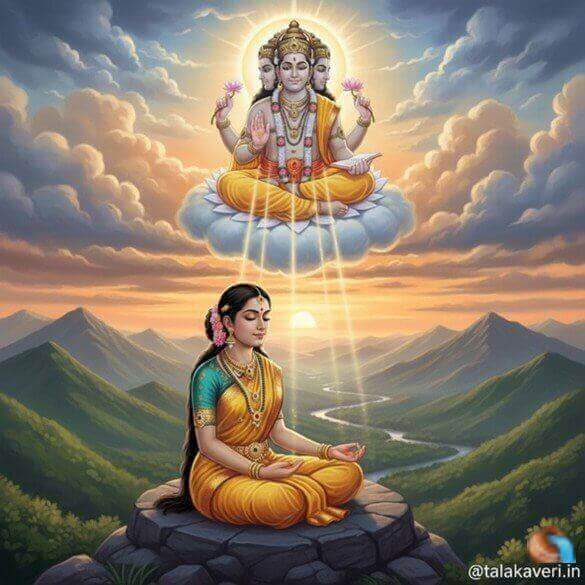
The Goddess Kaveri, initially known as Lopamudra, was created by Lord Brahma himself and adopted by the ascetic King Kavera Muni. Driven by a profound desire to cleanse the world of its sins and bring fertility to the barren lands, she approached Brahma with a sacred request: to allow her to become a holy river whose waters would absolve people's sins and bring agricultural prosperity to South India. Moved by her compassion for humanity, Brahma granted her wish, setting in motion one of the most significant divine manifestations in Hindu mythology.

The Sage's Vow

2. The Sage's Sacred Vow

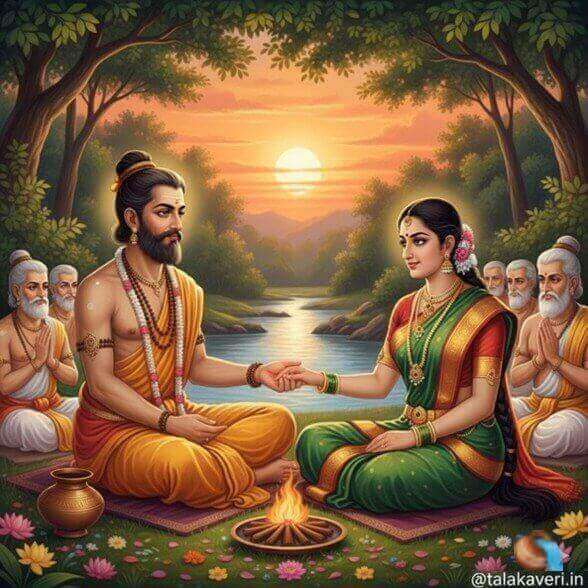
The wise sage Agastya, renowned for his spiritual power and mission to bring balance to the Indian subcontinent, sought to bring purifying waters to the arid Deccan Plateau. He approached Goddess Kaveri and asked her to marry him, so he could carry her sacred waters to the parched southern lands. She agreed to this divine union, but with one strict and non-negotiable condition: if Agastya ever left her alone for too long during their journey, she would immediately leave him to follow her destined path as a flowing river. The sage, understanding the gravity and importance of this vow, solemnly agreed to never abandon her.

The Pot and the Prayer

3. The Sacred Vessel on the Hill

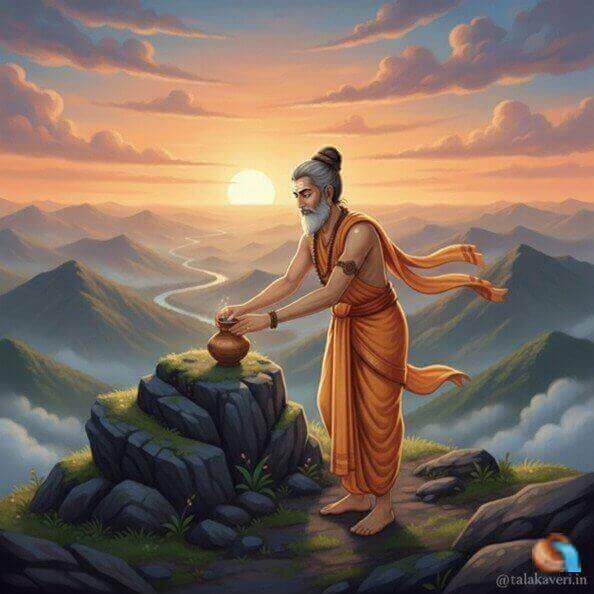
To carry the water safely to the dry land, Agastya contained Kaveri's concentrated, sacred form inside a small, powerful vessel—a Kamandalu. This pot held the promise of life for millions. The sage finally reached the misty Brahmagiri Hills in Kodagu . Exhausted, he placed the Kamandalu gently on the mountain peak to perform his important evening prayers. Inside the pot, the goddess waited, knowing the moment for her freedom was near.

Lord Ganesha's Intervention

4. Lord Ganesha's Divine Intervention

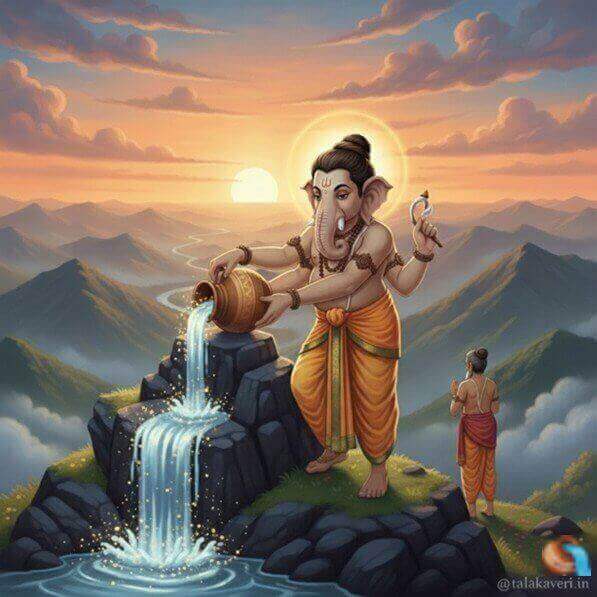
This was the moment of cosmic destiny. Knowing that the sage's duty of carrying the water was complete and that the river needed to flow for the ultimate benefit of humanity, Lord Ganesha, the remover of obstacles and enabler of destiny, appeared at that exact spot in disguise. Understanding the greater divine plan, Ganesha gently but firmly tipped the Kamandalu over with his hand or trunk, allowing the sacred waters to spill onto the rocks. This was not an act of mischief but a deliberate fulfillment of cosmic purpose, ensuring that Goddess Kaveri would begin her ordained journey to sustain millions of lives.

The River's Flow

5. The River's Eternal Flow at Talakaveri

The sacred water flowed out onto the ancient rocks, and Goddess Kaveri, considering Agastya's condition broken (as he had left her alone), immediately burst forth with divine energy and began her unstoppable journey as a mighty river. The exact spot where the water first sprang from the earth is the revered holy site known as Talakaveri (meaning "head of Kaveri"). This divine manifestation is celebrated as the sacred moment when the Kodava people gained their Kuladevi (Clan Goddess), forever linking their identity, culture, and prosperity to the river. To this day, the Kunda (sacred spring tank) at Talakaveri marks this holy origin, and water continues to bubble up during the annual Kaveri Sankramana festival, reaffirming the Goddess's eternal presence.

🎉 Kaveri Sankramana Festival 🎉

The sacred moment when Goddess Kaveri manifests at Talakaveri

3
Days
4
Hours
51
Minutes
19
Seconds

Date: Mid-October (Tula Sankramana) • Location: Talakaveri, Kodagu, Karnataka

🪔 Diwali Festival 🪔

The festival of lights symbolizing the victory of light over darkness.

15
Days
6
Hours
30
Minutes
45
Seconds

Date: November 2025 • Location: Celebrated across India

🌺 Navaratri Festival 🌺

Celebrating the divine feminine energy across nine sacred nights.

20
Days
2
Hours
45
Minutes
30
Seconds

Date: October 2025 • Location: Throughout India

🌊 Interactive River Journey Map 🌊

Follow the sacred 800 km journey of Goddess Kaveri from the Brahmagiri Hills to the Bay of Bengal. Click on each temple marker to discover its significance and unlock badges!

📍 Journey Statistics

800
Kilometers
2
States
12+
Major Temples
3
Sacred Sangams

🕉️ Sacred Sites Along the Kaveri 🕉️

Discover the magnificent temples and holy sites that mark the path of Goddess Kaveri's divine journey

Talakaveri Temple

Brahmagiri Hills, Kodagu (Coorg), Karnataka

Significance

The Talakaveri Temple marks the sacred source, or talai (head), of the Kaveri River. It is the physical location of the river's divine manifestation on Earth, celebrated through the Agastya legend. The temple complex includes a small spring tank, the Kunda, from which the river officially originates before flowing underground and emerging later downstream.

Historical and Cultural Importance

The temple is the foremost shrine of the Kodava community, who consider Goddess Kaveri their Kuladevi (Clan Goddess). Their entire culture, land, and identity are intimately tied to the river's purity and flow. The site is the center of the highly revered annual Kaveri Sankramana festival (mid-October), when water in the sacred Kunda visibly bubbles up, marking the Goddess's appearance. Thousands of pilgrims gather to witness this miraculous event and collect the holy water.

Architecture

The temple is built in a simple, traditional Kerala style with a modest structure that emphasizes spiritual simplicity over architectural grandeur. A small shrine houses the deity, and the sacred Kunda is the focal point where devotees perform rituals and collect holy water.

Bhagamandala

Kodagu, Karnataka (8 km from Talakaveri)

Significance

Bhagamandala is revered as a Triveni Sangam, a sacred meeting point where the Kaveri meets two of its main tributaries: the Kanike and the mythical Suvarnavathi. This triple confluence is considered highly sanctified and often called the "Kashi of Kodagu." The convergence of three rivers amplifies the spiritual power of the location exponentially.

Historical and Cultural Importance

Bhagamandala is a major center for performing ancestral rites (Pitr-Karya), with pilgrims believing that prayers and immersion ceremonies here grant immense spiritual merit, particularly before ascending to Talakaveri. The site is dominated by the ancient Bhagandeshwara Temple dedicated to Lord Shiva, featuring four main shrines. Devotees believe that bathing at the sangam absolves sins and brings blessings for ancestors.

Temple Features

  • Four shrines: Bhagandeshwara (Shiva), Maheshwara (Shiva), Chandramouleshwara (Shiva), and Subramanya
  • Kerala-style architecture with copper-plated roofs
  • Sacred bathing ghats at the confluence point
  • Annual festivals during Shivaratri and Kaveri Sankramana

Srirangapatna - Adi Ranga

Mandya District, Karnataka

Significance

Srirangapatna is the site of the Sri Ranganatha Swamy Temple, the first (Adi) of the three most sacred Tri-Ranga Kshetrams on the Kaveri River. Dedicated to Lord Vishnu (Ranganatha) in a reclining posture (Anantashayana), the temple is situated on an island formed by the bifurcation of the Kaveri River, symbolizing Lord Vishnu's cosmic rest on the serpent Adisesha.

Historical and Cultural Importance

This shrine is one of the oldest Ranganatha temples in the region, with origins dating back to at least the 9th century CE during the reign of the Ganga Dynasty. Beyond its spiritual role, Srirangapatna served as the vital political and military capital of the Mysore Kingdom under the Muslim rulers Hyder Ali and his son Tipu Sultan in the 18th century, creating a unique fusion of spiritual sanctity with political power. The town witnessed major historical events including battles with the British East India Company, culminating in the Siege of Srirangapatna in 1799.

Religious Significance

  • First of the three Ranganatha temples (Adi, Madhya, Antya)
  • Represents the beginning of the spiritual journey along Kaveri
  • Vishnu reclines facing south, blessing devotees
  • Important Vaishnava pilgrimage center

Shivanasamudra - Madhya Ranga

Mandya District, Karnataka

Significance

Shivanasamudra is home to the Ranganatha Swamy Temple, designated as the second (Madhya) of the Tri-Ranga Kshetrams. The temple sits on a large island formed by the Kaveri River's bifurcation into two channels, representing the midpoint of the sacred pilgrimage journey along the river.

Natural Wonder

The island is located just upstream of the spectacular Shivanasamudra Falls, the Gaganachukki Falls on one side and the Bharachukki Falls on the other. These twin waterfalls represent the raw, untamed force and power of Goddess Kaveri. During the monsoon season, the falls transform into a thundering cascade that demonstrates the river's might, with water plunging over 90 meters into rocky gorges below.

Historical and Cultural Importance

This site also houses one of Asia's first hydroelectric power stations, commissioned in 1902, connecting the river's spiritual reverence with its modern economic importance. The power station, built during the reign of the Mysore Kingdom, supplied electricity to the Kolar Gold Fields, making it a pioneering achievement in Indian industrial history. This symbolizes how Goddess Kaveri continues to provide sustenance, both spiritual and material, to millions.

Talakadu - The Buried City

Mysore District, Karnataka

Significance

Talakadu is a mysterious and historically rich site where most ancient temples lie buried under vast sand dunes, a phenomenon attributed to a famous curse. The city is revered for the Panchalinga Temples, five major Shiva shrines that represent the five elements of nature (Pancha Bhoota).

The Five Sacred Lingas

  • Vaidyanatheshwara - The healing deity
  • Pataleshwara - The underground deity, mostly buried in sand
  • Maruleshwara - The deity of illusion
  • Arkeshwara - The sun deity
  • Mallikarjuna - The jasmine-lord deity

Panchalinga Darshana Festival

The primary spiritual draw is the Panchalinga Darshana festival, a highly sacred event held approximately once every twelve years when the full moon coincides with specific planetary alignments. During this rare occasion, pilgrims visit all five Shiva temples in a prescribed order after taking a purifying dip in the Kaveri River. Thousands of devotees gather for this once-in-a-decade event, believing it grants liberation from the cycle of rebirth.

The Legend of Alamelamma's Curse

According to legend, Queen Alamelamma of the Vijayanagara Empire cursed the city after being persecuted by the Raja of Mysore. She drowned herself in the Kaveri River at Talakadu, cursing that "Talakadu shall become sand, Malangi a whirlpool, and the Mysore Rajas shall fail to beget heirs." The city was subsequently engulfed by sand, and the temples remain partially buried to this day, creating an eerie and mystical landscape.

Somnathpur Chennakesava Temple

Near Mysore, Karnataka

Significance

The Chennakesava Temple at Somnathpur is a magnificent crown jewel of the Hoysala architectural style, representing the pinnacle of medieval South Indian temple architecture. Dedicated to Lord Keshava (Vishnu), its location on the banks of the Kaveri River symbolizes how the river's prosperity fostered the peak of South Indian art, culture, and temple-building during the Hoysala Dynasty (10th-14th centuries CE).

Architectural Marvel

Built in 1268 CE by Soma, a general under Hoysala King Narasimha III, the temple is famous for its:

  • Intricate star-shaped platform (trikuta style with three shrines)
  • Exquisitely detailed stone carvings depicting scenes from Hindu epics
  • Lathe-turned pillars with incredible precision
  • Soapstone construction allowing for minute detailing
  • Depictions of the Ramayana, Mahabharata, and Bhagavata Purana

Cultural Importance

The temple stands as a testament to the artistic and cultural renaissance that flourished along the Kaveri River during the Hoysala period. Every inch of the temple walls is covered with intricate sculptures of deities, celestial beings, animals, and floral motifs, demonstrating the unparalleled skill of medieval Indian sculptors. The temple is protected as a UNESCO World Heritage Site candidate.

Bhavani Kooduthurai Sangam

Erode District, Tamil Nadu

Significance

Bhavani Kooduthurai marks a profoundly sacred Triveni Sangam where the mighty Kaveri joins the Bhavani River and the mythical underground Amudha Nadi (River of Nectar). This triple confluence is considered one of the most sanctified meeting points of rivers in South India, comparable to the Triveni Sangam at Prayagraj (Allahabad) in North India.

Religious Practices

Devotees believe that ritual bathing (snanam) here cleanses all sins accumulated over lifetimes and fulfills prayers for spiritual liberation. The meeting of three rivers creates a powerful energy vortex that amplifies the sanctity of rituals performed here. Many pilgrims perform tarpana (ancestral rites) and shraddha ceremonies for departed souls.

Sangameswarar Temple

The confluence is sanctified by the ancient Sangameswarar Temple dedicated to Lord Shiva, which also houses a shrine for Lord Vishnu, emphasizing its importance to both Shaivite and Vaishnavite traditions. The temple is celebrated in the ancient devotional hymns of the Thevaram, composed by the Tamil Nayanars (Shaivite saints) during the 6th-9th centuries CE, confirming its antiquity and spiritual significance.

Festival

The annual Bhavani Sangamam festival attracts thousands of pilgrims who take holy dips and perform elaborate pujas at the confluence, especially during auspicious days like Makar Sankranti and Thai Poosam.

Srirangam - Antya Ranga

Tiruchirappalli (Trichy), Tamil Nadu

Significance

Srirangam is the final (Antya) and most revered of the Tri-Ranga Kshetrams. Dedicated to Sri Ranganathaswamy (Lord Vishnu in reclining posture), it is the undisputed epicenter of Vaishnavism in South India. The temple is situated on a massive island formed by the Kaveri River and its major tributary, the Kollidam (Coleroon), creating a naturally sacred space surrounded by holy waters.

Architectural Grandeur

This is the largest functioning Hindu temple complex in the world, sprawling across 156 acres (631,000 square meters). The temple features:

  • Seven concentric enclosure walls (prakarams) representing the seven layers of existence
  • 21 unique towers (gopurams), with the Rajagopuram standing at 72 meters (236 feet), one of Asia's tallest temple towers
  • 50 sub-shrines dedicated to various deities
  • Hall of 1000 pillars (Ayiram Kaal Mandapam) showcasing Dravidian architecture
  • The innermost sanctum with Lord Ranganatha reclining on Adisesha

Religious Significance

Srirangam is one of the 108 Divya Desams, the most sacred Vishnu temples celebrated in the Divya Prabandha, a collection of 4,000 Tamil verses composed by the Azhwar saints between the 6th and 9th centuries CE. The temple is mentioned in numerous ancient texts and has been a center of the Sri Vaishnava tradition for over a millennium. Great philosophers like Ramanuja lived and taught here in the 11th-12th centuries.

Historical Importance

The temple has witnessed numerous historical events, including invasions by the Delhi Sultanate in the 14th century and the Vijayanagara Empire's patronage. Despite destruction and reconstruction, it has remained a living center of worship and Vaishnava philosophy for over 1,500 years.

Kumbakonam - Temple City

Thanjavur District, Tamil Nadu

Significance

Known as the "Temple City" or "Cambridge of South India," Kumbakonam is the spiritual nexus of the fertile Kaveri Delta, home to dozens of major temples symbolizing the ultimate richness and spiritual bounty of the river's final stages. The city is blessed with the presence of both Shiva and Vishnu temples, making it a pilgrimage destination for all Hindu sects.

Mahamaham Festival

The city is world-famous for the Mahamaham festival, held once every 12 years when Jupiter enters the zodiac sign of Leo (Simha Rasi). During this cosmic alignment, millions of pilgrims from across India and abroad gather to take a purifying dip in the Mahamaham tank, a sacred reservoir in the heart of the city. Devotees believe that during this auspicious time, all major holy rivers of India, including the Ganga, Yamuna, Godavari, Saraswati, Narmada, Sindhu, and Kaveri, converge mystically in this tank, making a dip here equivalent to bathing in all seven sacred rivers simultaneously.

Major Temples

  • Kumbeswarar Temple (Shiva) - One of the largest Shiva temples with intricate architecture
  • Sarangapani Temple (Vishnu) - One of the Divya Desams
  • Ramaswamy Temple - Known for its exquisite Nayak-period frescoes
  • Nageswaran Temple - Showcases Chola architectural brilliance

Cultural Heritage

Kumbakonam was a center of learning, art, and culture during the Chola Dynasty. The city produced renowned scholars, musicians, and artisans. The Kaveri's fertile delta provided the agricultural surplus that allowed such cultural flourishing, proving once again the Goddess's role as both material provider and spiritual sustainer.

Mayiladuthurai - The Sacred Dip

Mayiladuthurai District, Tamil Nadu

Significance

Mayiladuthurai, meaning "Town of the Dancing Peacock," is named after the legend that Lord Shiva appeared here as a peacock (mayil) to worship Lord Vishnu. The town houses the famous Mayuranathaswamy Temple dedicated to Lord Shiva and is crucial for ritual bathing at a designated sacred point on the Kaveri River.

Thula Snanam - The Auspicious Bath

Devotees consider a dip in the Kaveri at Mayiladuthurai during the sacred Thula Snanam period (mid-October to mid-November, when the sun transits through Libra/Tula) to be immensely auspicious. This month-long period is believed to cleanse the soul of all impurities, wash away karmic debts, and grant spiritual merit equivalent to performing a thousand yagnas (fire rituals). Thousands gather daily during this period to bathe in the river before dawn.

Temple Significance

The Mayuranathaswamy Temple is one of the Paadal Petra Sthalams (temples praised in the Thevaram hymns by Tamil Nayanar saints). The temple is architecturally significant, featuring:

  • A five-tiered gopuram with intricate sculptures
  • Ancient inscriptions dating back to the Chola period
  • A sacred tank where devotees perform ablutions before temple worship
  • Shrines for various deities including Durga, Ganesha, and Murugan

Mythology

According to legend, this is where the peacock (vehicle of Murugan and symbol of Shiva) performed penance and was granted moksha. The myth connects the site to both Shaivite and Vaishnava traditions, highlighting the inclusive nature of Kaveri's spiritual influence.

Poompuhar - The River's End

Mayiladuthurai District, Tamil Nadu

Significance

Poompuhar (also known as Kaveri Poompattinam) marks the sacred conclusion of Goddess Kaveri's long 800-kilometer journey as she empties into the Bay of Bengal, fulfilling her divine destiny to bring life, prosperity, and spiritual cleansing all the way to the sea. This is where the freshwater of the river meets the salt water of the ocean, symbolizing the merging of individual consciousness with universal consciousness.

Historical Importance

Poompuhar was once a legendary and prosperous port city of the early Chola Dynasty (3rd century BCE to 3rd century CE) and a thriving international trade center. Ancient Tamil literature describes it as a cosmopolitan city with separate quarters for foreign merchants from Rome, Greece, and Southeast Asia. Ships laden with spices, precious stones, silk, and pearls departed from this harbor, spreading South Indian culture across the ancient world.

Literary Significance

Poompuhar is celebrated in classical Tamil literature, particularly in the immortal epic Silappatikaram (The Tale of an Anklet), composed by Prince Ilango Adigal around the 2nd century CE. The epic describes the city's grandeur, its bustling markets, magnificent palaces, and the vibrant cultural life sustained by Kaveri's abundance. The protagonist Kovalan and his wife Kannagi's tragic story begins in this very city.

Archaeological Evidence

Modern archaeological excavations have uncovered evidence of the ancient city submerged beneath the sea due to gradual coastal erosion and possible tsunamis. Artifacts including Roman coins, pottery, and building remains confirm the city's historical existence and its role as a major trading hub. The site serves as the symbolic conclusion of the sacred Tirtha Yatra along the Kaveri.

Spiritual Symbolism

The merging of Goddess Kaveri with the ocean represents the soul's return to the universal source, completing the cycle of spiritual evolution. Pilgrims who reach Poompuhar have symbolically traveled from the river's divine birth at Talakaveri to its cosmic dissolution in the infinite ocean, a journey from origin to ultimate merger with the divine.

🙏 Worship and Festivals 🙏

Discover the vibrant tapestry of rituals, festivals, and daily devotion that celebrates Goddess Kaveri as a living deity

Kaveri: The Living Goddess, The Celebrated Lifeline

More than a river, Kaveri is revered as Kaveramma, a living deity whose grace sustains millions. Her passage through the landscape is a continuous act of divine giving, and in return, communities on her banks have, for millennia, expressed their gratitude and devotion through a rich tapestry of festivals, rituals, and daily acts of worship. These celebrations are vibrant expressions of faith, thanksgiving, and profound respect for the benevolent Mother who bestows fertility, prosperity, and spiritual purity upon the land and its people. From her mountainous source to her deltaic embrace with the sea, every bend of Kaveri's course resonates with the prayers and joyous festivities of her devotees.

Kaveri Sankramana: The Miracle of Divine Manifestation

Significance: Kaveri Sankramana is the most profound and revered annual festival celebrating the divine manifestation of Goddess Kaveri at her source in Talakaveri. It marks the precise astrological moment when the Sun transitions into the Tula (Libra) Rashi, a period steeped in myth and miracle. For pilgrims, this is not merely an observance but a direct communion with the benevolent Mother Kaveri as she blesses the Earth with her life-giving waters, reaffirming her eternal presence.

Miracles and Beliefs

  • The Holy Springing (Teerthodbhava): The central miracle of Kaveri Sankramana is the spontaneous springing forth of water from the sacred Kunda (a small spring tank). At the exact auspicious moment, water is observed to bubble up and overflow, a phenomenon known as Teerthodbhava. This effervescent surge is universally regarded as the Goddess Kaveri herself making her divine appearance, pouring her grace onto the world.
  • The Ever-Flowing Source: Despite variations in rainfall, the Kunda at Talakaveri is believed to never dry out, serving as a constant, miraculous source for the mighty river, ensuring continuous flow even through dry seasons—a testament to Kaveri's enduring power.
  • Auspiciousness for All Beginnings: Taking a holy dip during Sankramana is believed to be exceptionally potent. It is said to cleanse all sins, purify the soul, and usher in prosperity. Many new ventures, marriages, and spiritual endeavors are ideally commenced after seeking blessings during this auspicious period.
Rituals and Celebrations
  • Vigil and Witnessing: Devotees undertake a pilgrimage to Talakaveri, often camping overnight, to be present at the exact moment of Teerthodbhava. Chants, prayers, and hymns fill the air, creating an atmosphere of intense spiritual fervor.
  • Sacred Bathing (Tula Snanam): Immediately following the divine springing, pilgrims immerse themselves in the consecrated waters of the Kunda or the adjacent river. This ritual bath is the heart of the festival's purification aspect.
  • Offerings and Ancestral Rites: Elaborate pujas are performed at the Talakaveri Temple. Beyond the source, across the Kaveri basin, households offer special prayers to the river, presenting fresh produce and flowers, expressing gratitude for her bounty. Many also perform Pitt-Tarpana (offerings to ancestors) by the river banks during this period.
  • Cultural Importance: While deeply intertwined with the spiritual and cultural identity of the Kodava community, for whom Kaveri is their Kuladevi (Clan Goddess), the sanctity and miraculous nature of Kaveri Sankramana resonate far beyond Coorg, drawing pilgrims and spiritual seekers from across Karnataka, Tamil Nadu, and even further afield.

Aadi Perukku: The Festival of River's Bounty

Significance: Aadi Perukku, also known as Padinettam Perukku (the 18th day celebration), is a unique and vibrant Tamil festival dedicated to expressing gratitude to the Kaveri River. Celebrated on the 18th day of the Tamil month of Aadi (mid-July to mid-August), this festival marks the rising water levels in the Kaveri, a crucial sign of the forthcoming agricultural prosperity as the monsoon rains replenish her source. It is a heartfelt thanksgiving for the life-sustaining waters that irrigate fields, nourish livestock, and support entire communities, primarily in Tamil Nadu.

Rituals and Celebrations
  • Celebration of Fertility and Life: The festival is deeply intertwined with fertility and agricultural abundance. Farmers look to the swelling waters as a promise of a bountiful harvest, and the festival acts as a prayer for continued prosperity.
  • Offerings to the River: Devotees flock to the banks of the Kaveri and its canals, especially in the delta region. Women, particularly, play a central role, making elaborate offerings to the river. These include varieties of cooked rice (Chitramam), sweet dishes, flowers, bangles, turmeric, and vermilion, symbolizing devotion and seeking blessings for marital harmony and prosperity.
  • Symbolic Marriages and Adornments: Newly married couples often visit the river to offer prayers. Women float lamps and bangles in the river, treating Kaveri as a divine Mother or a revered elder receiving gifts. Young girls perform rituals to seek blessings for a good spouse.
  • Communal Feasting (Kootanchoru): A significant aspect of Aadi Perukku is the communal feasting. Families and friends gather on the riverbanks for picnics, sharing meals that symbolize unity and collective gratitude for Kaveri's bounty. The atmosphere is one of immense joy, celebration, and community spirit.
  • Cultural Importance: Aadi Perukku transcends mere religious ritual; it is a profound cultural expression of Tamil Nadu's intrinsic link to the Kaveri. It celebrates the interdependent relationship between humanity and nature, acknowledging the river as the ultimate provider and protector of their civilization.

Thula Snanam: The Sacred Bath of Purification

Significance: Thula Snanam refers to a highly auspicious month-long period (mid-October to mid-November) when taking a holy dip (snanam) in the Kaveri River is considered exceptionally sacred and purifying. This period corresponds to the sun's transit into the Tula (Libra) rashi, aligning with the same astrological window as Kaveri Sankramana at the source. It is widely believed that during this month, all other holy rivers and deities converge into the Kaveri, making her waters especially potent for spiritual cleansing.

Miracles and Beliefs

  • Convergence of Holy Waters: The central belief of Thula Snanam is that during this specific month, the Ganges and other sacred rivers of India, along with various deities, descend to bathe in the Kaveri. This divine convergence imbues the Kaveri's waters with extraordinary power to wash away sins and grant profound spiritual merit.
  • Healing Properties: Devotees also believe that the waters, especially during this period, possess healing properties, capable of curing ailments and promoting overall well-being.
  • Ancestral Blessings: Performing Pür-Tarpana (offerings to ancestors) during Thula Snanam is considered highly beneficial, ensuring peace and salvation for departed souls.
Rituals and Celebrations
  • Ritual Bathing: Pilgrims, often in large numbers, undertake regular ritual dips in the Kaveri throughout the month. Specific ghats (steps leading to the river) in towns like Mayiladuthurai, Kumbakonam, and Srirangam become major centers for these holy baths.
  • Offerings and Pujas: Alongside bathing, offerings of flowers, incense, lamps, and food are made to Goddess Kaveri. Special pujas are conducted in the temples situated on her banks, seeking blessings for health, prosperity, and spiritual growth.
  • Culmination at Mayiladuthurai: The Thula Snanam typically culminates with a grand final dip at the Mayuranathaswamy Temple in Mayiladuthurai, after which the purifying power of the Kaveri is believed to return to its origin, recharging for the next annual cycle.

Cultural Importance

Thula Snanam underscores the Kaveri's status as a "Dakshina Ganga" (Ganges of the South), a river whose sanctity rivals that of the Ganges itself. It reinforces the river's role as a primary source of spiritual renewal and underscores the deep faith of millions in her divine attributes.

General Daily Reverence: Kaveri as a Way of Life

Beyond the grand annual festivals, the reverence for Kaveri is woven into the very fabric of daily life for countless communities inhabiting her basin. She is not just a distant deity but an intimate presence, a Mother Goddess whose grace is experienced in every drop of water used for sustenance, agriculture, and spiritual practice.

  • Daily Offerings (Puja): Many households along the Kaveri's course begin their day with a simple act of devotion – an offering of flowers, a lit lamp, or a respectful prayer (namaskaram) to the river. Before drawing water for daily needs, a silent prayer of gratitude is common.
  • Life-Giver and Sustainer: The river's role as a life-giver is never forgotten. She quenches thirst, irrigates vast fields of paddy and sugarcane, supports fishing communities, and nourishes the biodiversity of the region. This tangible sustenance fosters a deep, almost familial, bond between the people and the river.
  • Cultural and Ritual Significance: Kaveri's water is considered theertham (holy water) and is integral to countless Hindu rituals, from auspicious ceremonies like housewarmings and weddings to funeral rites, symbolizing purity and continuity. No major temple festival in the basin is complete without involving the sacred waters of Kaveri.
  • Expression of Gratitude: The constant flow of the Kaveri is seen as a continuous blessing, inspiring songs, folklore, and local traditions that perpetuate her sacred narrative through generations. This daily, quiet reverence ensures that Kaveramma's divine presence is acknowledged and celebrated in every aspect of life.

🌄 Kodava Culture and Kaveri 🌄

Discover the profound bond between the Kodava people and their Divine Mother Kaveri

Introduction: Kaveri, The Soul of Kodagu and Kuladevi of the Kodavas

Nestled amidst the verdant hills and dense forests of Kodagu (Coorg), lies a culture as unique and resilient as the landscape itself: that of the Kodava people. For this proud and distinctive community, the Kaveri River is far more than a geographical feature or a source of sustenance; she is the very soul of their land, their ancestral Mother, and their revered Kuladevi (Clan Goddess). Indeed, from the moments of birth to the final rites of passage, the entire life cycle of the Kodava people is profoundly intertwined with and sanctified by Goddess Kaveri. The life, identity, rituals, and festivals of the Kodavas are so intrinsically interwoven with Kaveri that one cannot speak of one without profoundly understanding the other. Their bond is ancient, deeply spiritual, and manifested in every significant aspect of their existence, from the daily puja to the most sacred life-cycle ceremonies.

Kaveramma as Kuladevi: The Guardian Mother

For the Kodavas, Kaveramma is not merely one deity among many; she holds the supreme position as their Kuladevi – the ancestral deity and guardian of their lineage, clan, and homeland. This elevates her status beyond a generic river goddess to a deeply personal, protective mother figure.

  • A Personal Deity: Unlike other Hindu communities where a Kuladevi might be a specific temple deity, for the Kodavas, their Kuladevi is the river herself, physically present and constantly flowing through their land. This fosters an exceptionally intimate and direct relationship with the divine.
  • Source of Identity and Prosperity: The health and bounty of the Kaveri are directly linked to the well-being and prosperity of the Kodava people. She provides the water for their staple rice cultivation, sustains their coffee plantations, and nurtures the rich biodiversity of their homelands. Her uninterrupted flow is seen as a continuous blessing from their divine Mother.
  • The Agastya Legend (Kodava Perspective): While the broader Hindu tradition attributes Kaveri's descent to the prayers of Sage Agastya, the Kodava narrative emphasizes her choosing their land as her source. This reinforces their unique proprietorship and sacred guardianship over her origin. The tale often highlights Agastya's devotion and Lord Ganesha's intervention in releasing Kaveri from the Kamandalu, ensuring she would flow specifically through Kodagu, destined to bring prosperity to the entire south.
  • Protection and Guidance: As Kuladevi, Kaveramma is believed to protect her children (the Kodavas) from harm, guide them in their endeavors, and ensure the fertility of their women and their land. All major decisions, ventures, and celebrations invariably invoke her blessings.

Life Cycle Rituals and Kaveri's Blessings: A Sacred Thread

From birth to marriage to ancestral rites, the Kaveri River is an omnipresent and sacred thread binding the life of every Kodava. Her purifying waters and benevolent spirit are invoked at every significant milestone, solidifying the intimate bond between the people and their Divine Mother.

Marriage Rituals: A Union Sanctified by Kaveramma

Kodava marriages are culturally distinct, often performed at the ancestral Ainmane (family home) without a Brahmin priest. Instead, the focus is on family elders, ancient customs, and the blessings of their Kuladevi, Kaveramma.

  • Initial Invocation and Sacred Pot (Kumbha): The marriage ceremony traditionally begins with a direct invocation of Goddess Kaveri. A specially decorated pot (kumbha) filled with fresh water, often drawn directly from the Kaveri or a consecrated local spring representing her, is central to the rites.
  • Blessings from the Elder Woman (Baja): An important ritual involves the Boja, an elder woman from the family, who plays a pivotal role in sanctifying the union. She performs specific rites, often involving the sacred water representing Kaveri.
  • The Sacred Dip at Bhagamandala: Following the main ceremony, a cornerstone of the post-nuptial celebrations is the ritual visit of the newlywed couple to Bhagamandala (or another designated holy bathing spot on the Kaveri).
Birth and Naming Ceremonies: Welcoming New Life under Kaveri's Auspices

The arrival of a new child is a momentous occasion, and Kaveri's life-giving essence is subtly invoked to bless the newborn and ensure their well-being.

  • Purificatory Baths with Sacred Water: Following the initial period after birth, when the mother and child are secluded, water from the Kaveri (or consecrated local spring water representing her) is often used for the mother and baby's first purificatory baths.
  • Seeking Kaveri's Grace in Naming: While specific direct rituals involving the river for naming are not as elaborate as for marriage, during the naming ceremony, prayers are offered to Kaveramma. The family seeks her blessings for the child's long life, robust health, and prosperous future.
Ancestral Rites (Karnang Kodpo and Pitt-Tarpana): Journeying with the Mother

The Kodava reverence for ancestors (Guru Karana) is profound, and the sacred waters of Kaveri play an indispensable role in ensuring peace and continuity for departed souls.

  • Offerings at Sacred Confluences: During specific ancestral remembrance rituals, particularly at Bhagamandala (the Triveni Sangam where the Kaveri meets Kanike and Suvarnavathi), offerings (Ptir-Tarpana – oblations to ancestors) are made.
  • Kaveri Sankramana Ancestral Offerings: During the auspicious Kaveri Sankramana festival, beyond celebrating the Goddess, many Kodava families perform special ancestral rites on the riverbanks.
  • Water for Final Rites: In the solemn final rites, a few drops of Kaveri water (or symbolically pure water) might be offered to the deceased, or remnants of the ashes immersed in her sacred currents.

Festivals of Gratitude and Abundance: Celebrating Kaveramma's Bounty

The Kodava calendar is punctuated by vibrant festivals, many of which are profound expressions of gratitude to Kaveramma for her continuous blessings of fertility and abundance, particularly evident in their agricultural cycles.

Puthari: The Harvest Festival of Gratitude

Puthari (meaning "new rice") is the most significant harvest festival of the Kodava community, typically celebrated in late November or early December. It is a joyous occasion marking the reaping of the first rice harvest, and Kaveri's grace is at the very heart of its celebration.

  • Symbolic Harvest and Invocation: The festival commences with a traditional ceremony where the head of the family, usually accompanied by family members, proceeds to the rice fields. At an auspicious hour, typically after sunset, a few sheaves of paddy are ceremonially cut and brought back to the Ainmane (ancestral home).
  • The Chant of "Poli Poli Deva": As the paddy is brought home, the family chants "Poli Poli Deva" ("Grow, grow, God/Goddess"), a prayer for prosperity and continued abundance. This chant is a direct appeal to the divine forces, including Kaveramma.
  • Feasting and Community: The new rice is threshed, roasted, and powdered to make Puthari Kamji (a special rice gruel) or Kadambuttu (rice dumplings), which are offered to the family deities and then shared among the family and community.
  • Kaveramma's Blessing for Fertility: Puthari is a profound acknowledgment that the fertile soil and the abundant harvest are direct gifts from Kaveramma. The rituals ensure that the first fruits of the land are shared with her spirit, renewing the covenant of prosperity between the people and their benevolent River Goddess.

Kaveri Sankramana: Kodava's Sacred Vigil and Storage of Holy Water

While Kaveri Sankramana is a pan-Kaveri phenomenon, for the Kodavas, it carries an exceptionally personal and ancestral significance, marking the very moment their Kuladevi manifests at her source.

  • The Sacred Vigil at Talakaveri: Thousands of Kodavas undertake a pilgrimage to Talakaveri. They participate in a solemn vigil, often staying overnight, to witness the miraculous Teerthodbhava – the bubbling up of water in the Kunda at the precise auspicious moment.
  • Bringing Home the Holy Water (Tirtha): A unique and central Kodava custom during Kaveri Sankramana involves collecting the freshly manifested holy water (Tirtha) in bottles, pots, or brass vessels immediately after the Teerthodbhava.
  • Storage and Sacred Use: The collected Tirtha is considered extremely potent and is stored in a designated, revered place within the Ainmane or family home. This water is not for daily consumption but is reserved for highly sacred purposes throughout the year.
  • Reinforcing the Bond: This practice of storing the sacred spring water in every home powerfully reinforces the intimate, tangible, and continuous presence of Kaveramma in the daily and spiritual lives of the Kodava people, connecting them directly to her divine source.

Daily Puja and Home God (Pattedara / Guru Karana): Kaveri in the Sacred Hearth

Beyond grand festivals and life-cycle rituals, Goddess Kaveri's presence permeates the daily spiritual rhythm of Kodava life. Her spirit is deeply intertwined with their reverence for ancestral deities and the sanctity of their homes, ensuring her blessings are continuously invoked.

Daily Devotion: A Silent Acknowledgment

  • Morning Rituals: Many Kodava households begin their day with a simple yet profound act of devotion. A lamp may be lit, and a silent prayer offered to Kaveramma, often facing east towards the direction of the river's flow or the family's traditional Ainmane.
  • Water as Sacred: Water itself, in Kodava homes, carries a heightened sense of sanctity. While not always directly from Talakaveri for daily use, the general respect for water reflects their deep reverence for its divine source – Kaveri. Before fetching water from a well or tap, a brief prayer of gratitude is common.

Home God and Ancestral Shrines (Pattedara / Guru Karana): Kaveri's Enduring Presence

The Kodavas are known for their unique ancestral worship, where the spirits of revered ancestors (Guru Karana / Pattedara) are enshrined and worshipped within the Ainmane (ancestral home). Kaveri's spirit is intrinsically linked to these ancestral venerations.

  • Kaveri's Essence in the Home Shrine: While there may not be a dedicated idol for Kaveri in every home shrine, her presence is deeply felt and symbolically represented. Often, a small pot or vessel containing water (especially the consecrated Tirtha from Kaveri Sankramana) is placed within the Kanni Kombare (the sacred corner or ancestral prayer room of the Ainmane).
  • Invoking Ancestral and River Blessings: During daily prayers or specific ancestral rituals performed in the Ainmane, Kaveramma's blessings are implicitly invoked alongside those of the Pattedara. The ancestors, having lived their lives sustained by Kaveri, are believed to continue to guide and protect the family with her grace.
  • Reverence for Land and Nature: This daily reverence extends to a holistic respect for nature. The Kodavas' deep connection to their coffee estates, paddy fields, and the surrounding forests is an extension of their reverence for Kaveri, recognizing that the fertility of the land is a direct gift from the river goddess. Protecting these natural resources is seen as protecting Kaveramma herself.

Conclusion: An Unbreakable Bond - Kaveri, The Life-Force of Kodava Identity

The relationship between the Kodava people and Goddess Kaveri is far more than a cultural tradition; it is the very bedrock of their existence, identity, and spirituality. From the moment a child is welcomed into the world with purifying waters, through the sacred vows of marriage sanctified by her presence, to the joyous celebrations of Puthari that thank her for the harvest, and finally, in the rites that guide ancestors to peace in her currents – every significant phase of Kodava life is directly touched, blessed, and defined by Goddess Kaveri.

Her sacred waters, whether springing miraculously from Talakaveri, flowing majestically through their lands, or held in a consecrated pot within their homes, serve as a constant reminder of her benevolent presence. Kaveramma is not just their Kuladevi but their eternal Mother, protector, and provider. The Kodava devotion to Kaveri is a living testament to an ancient, profound, and unbreakable bond between a people, their land, and the divine river that has shaped their destiny for millennia.

📿 Kaveri Ashtottara Shatanamavali 📿

The 108 sacred names of Goddess Kaveri - chant these divine names for spiritual purification and blessings

Oṃ Namō Kāverī Mātā || Sarvamangaļa-pradāyinī ||

I bow to Mother Kaveri, the bestower of all auspiciousness

Oṁ Kāverī Mātā Namaḥ
Salutations to Mother Kaveri.
Oṁ Pāvanī Mātā Namaḥ
Salutations to the Purifying Mother.
Oṁ Vāriṇī Mātā Namaḥ
Salutations to the Water-Bearing Mother.
Oṁ Koḍava-Mātā Namaḥ
Salutations to the Mother of the Kodava people.
Oṁ Veda-rūpiṇī Namaḥ
Salutations to She who has the form of the Vedas.
Oṁ Nadī-rūpiṇī Namaḥ
Salutations to She who has the form of a sacred river.
Oṁ Teja-rūpiṇī Namaḥ
Salutations to She who embodies divine radiance.
Oṁ Mṛdu-rūpiṇī Namaḥ
Salutations to She who possesses a gentle and compassionate nature.
Oṁ Nirmala-Padma-hastā Namaḥ
Salutations to She who holds the pure lotus in her hand.
Oṁ Nitya-dhānya-hastā Namaḥ
Salutations to She whose hand bears eternal grains, symbolizing abundance.
Oṁ Tīrtha-kalaśa-hastā Namaḥ
Salutations to She who carries the sacred water vessel of pilgrimage and purity.
Oṁ Divyābhaya-hastā Namaḥ
Salutations to She whose divine hands grant fearlessness and protection.
Oṁ Agastya-priyā Namaḥ
Salutations to She who is beloved of Sage Agastya.
Oṁ Devatā-priyā Namaḥ
Salutations to She who is dear to all divine beings.
Oṁ Prakṛti-priyā Namaḥ
Salutations to She who loves and embodies all of Nature.
Oṁ Jananī-priyā Namaḥ
Salutations to She who is the loving and nurturing Mother of all creation.
Oṁ Kalyāṇī-priyā Namaḥ
Salutations to She who is beloved for her auspicious nature and benevolence.
Oṁ Vimalā-priyā Namaḥ
Salutations to She who is pure and radiant like crystal clarity.
Oṁ Jala-nī-priyā Namaḥ
Salutations to She who is fond of the sacred waters and rivers.
Oṁ Sāgara-priyā Namaḥ
Salutations to She who is dear to the vast and mighty ocean.
Oṁ Talakāverī-dhāma Namaḥ
Salutations to She who resides in the sacred abode of Talakaveri.
Oṁ Bhagamandala-dhāma Namaḥ
Salutations to She who dwells in the divine Bhagamandala confluence.
Oṁ Brahmagiri-dhāma Namaḥ
Salutations to She who abides in the holy Brahmagiri mountains.
Oṁ Śrīraṅganātha-dhāma Namaḥ
Salutations to She whose divine presence fills the abode of Lord Sriranganatha.
Oṁ Uraiyur-Nadī Namaḥ
Salutations to the River that sanctifies the sacred land of Uraiyur.
Oṁ Śrīraṅgam-Nadī Namaḥ
Salutations to the River that flows through the holy city of Srirangam.
Oṁ Thañjāvūr-Nadī Namaḥ
Salutations to the River that blesses the fertile region of Thanjavur.
Oṁ Pūmpuhār-Nadī Namaḥ
Salutations to the River that merges gracefully into the sea at Poompuhar.
Oṁ Jīvan-dhāriṇī Namaḥ
Salutations to She who sustains all life.
Oṁ Vasu-dhāriṇī Namaḥ
Salutations to She who bears and bestows wealth and prosperity.
Oṁ Dharma-dhāriṇī Namaḥ
Salutations to She who upholds righteousness and virtue.
Oṁ Sarva-dhāriṇī Namaḥ
Salutations to She who supports and nourishes all beings in the universe.
Oṁ Śuddha-jalā-dhāriṇī Namaḥ
Salutations to She who holds and bestows pure waters.
Oṁ Śubha-jalā-dhāriṇī Namaḥ
Salutations to She who carries auspicious and blessed waters.
Oṁ Tīrtha-jalā-dhāriṇī Namaḥ
Salutations to She who contains the sacred waters of pilgrimage and holiness.
Oṁ Sukha-jalā-dhāriṇī Namaḥ
Salutations to She who grants comfort and happiness through her flowing waters.
Oṁ Ponni-pradātrī Namaḥ
Salutations to She who bestows the sacred river Ponni (Kaveri).
Oṁ Anna-pradātrī Namaḥ
Salutations to She who grants nourishment and food to all beings.
Oṁ Phala-pradātrī Namaḥ
Salutations to She who rewards her devotees with fruitful outcomes.
Oṁ Dhana-pradātrī Namaḥ
Salutations to She who blesses her worshippers with wealth and prosperity.
Oṁ Dharma-pradātrī Namaḥ
Salutations to She who grants righteousness and moral virtue.
Oṁ Amṛta-pradātrī Namaḥ
Salutations to She who bestows the nectar of immortality and divine bliss.
Oṁ Puṇya-pradātrī Namaḥ
Salutations to She who rewards her devotees with spiritual merit and purity.
Oṁ Mokṣa-pradātrī Namaḥ
Salutations to She who grants liberation and eternal freedom from the cycle of birth and death.
Oṁ Kāverī-dvīpa-priyā Namaḥ
Salutations to She who loves the sacred islands formed by the Kaveri River.
Oṁ Tīrtha-saṅgama-priyā Namaḥ
Salutations to She who delights in the holy confluences of sacred waters.
Oṁ Dakṣiṇa-Kāśī-priyā Namaḥ
Salutations to She who is revered as the beloved of Dakshina Kashi (Southern Varanasi).
Oṁ Sapta-nadī-sā-priyā Namaḥ
Salutations to She who is cherished among the seven sacred rivers (Sapta Nadis).
Oṁ Annapūrṇā-rūpā Namaḥ
Salutations to She who has the divine form of Goddess Annapurna, the giver of nourishment.
Oṁ Lopāmudrā-rūpā Namaḥ
Salutations to She who manifests as Lopamudra, the devoted wife of Sage Agastya.
Oṁ Bhagavatī-rūpā Namaḥ
Salutations to She who embodies the form of the supreme Goddess Bhagavati.
Oṁ Mahāśakti-rūpā Namaḥ
Salutations to She who represents the great cosmic energy, Mahashakti, sustaining all creation.
Oṁ Jala-mālinī Namaḥ
Salutations to She who is adorned with the garland of flowing waters.
Oṁ Vana-mālinī Namaḥ
Salutations to She who is adorned with the garland of sacred forests.
Oṁ Giri-mālinī Namaḥ
Salutations to She who is adorned with the garland of holy mountains.
Oṁ Kṣetra-mālinī Namaḥ
Salutations to She who is adorned with the garland of sacred lands and fields.
Oṁ Puttari-utsava-pūjitē Namaḥ
Salutations to She who is worshipped during the Puttari harvest festival of Kodagu.
Oṁ Śrī Ādi-perukku-pūjitē Namaḥ
Salutations to She who is revered in the sacred Aadi Perukku festival celebrating prosperity and water abundance.
Oṁ Pavitra-vivāha-pūjitē Namaḥ
Salutations to She who is honored in holy and auspicious marriage ceremonies.
Oṁ Kāverī-Puṣkara-pūjitē Namaḥ
Salutations to She who is worshipped during the grand Kaveri Pushkaram, the sacred river festival.
Oṁ Jīva-pradātrī Namaḥ
Salutations to She who grants the gift of life to all beings.
Oṁ Śubha-pradātrī Namaḥ
Salutations to She who bestows auspiciousness and goodness.
Oṁ Sukha-pradātrī Namaḥ
Salutations to She who grants happiness and peace.
Oṁ Vara-pradātrī Namaḥ
Salutations to She who fulfills wishes and grants divine blessings.
Oṁ Vaṁśa-pradātrī Namaḥ
Salutations to She who blesses with a noble lineage and progeny.
Oṁ Śānti-pradātrī Namaḥ
Salutations to She who grants peace and harmony.
Oṁ Jñāna-pradātrī Namaḥ
Salutations to She who bestows divine knowledge and wisdom.
Oṁ Kānti-pradātrī Namaḥ
Salutations to She who radiates and grants spiritual brilliance and grace.
Oṁ Divya-nadī-pūjitā Namaḥ
Salutations to She who is worshipped as the divine and sacred river.
Oṁ Gaṅgā-sama-pūjitā Namaḥ
Salutations to She who is revered equally to the holy River Ganga.
Oṁ Grīṣma-vāha-pūjitā Namaḥ
Salutations to She who flows even in the scorching summer, blessing the land with life.
Oṁ Saṅkramaṇi-pūjitā Namaḥ
Salutations to She who is honored during the sacred Sankramana (solar transition) festival.
Oṁ Ṛtu-prasannā Namaḥ
Salutations to She who is pleased during all seasons and times of the year.
Oṁ Jala-prasannā Namaḥ
Salutations to She who brings joy and purity through her waters.
Oṁ Gati-prasannā Namaḥ
Salutations to She who grants auspicious movement and flow in life.
Oṁ Nitya-prasannā Namaḥ
Salutations to She who remains eternally serene, content, and blissful.
Oṁ Jaya-dāyinī Namaḥ
Salutations to She who bestows victory and success.
Oṁ Kṣamā-dāyinī Namaḥ
Salutations to She who grants forgiveness and compassion.
Oṁ Tṛpti-dāyinī Namaḥ
Salutations to She who gives satisfaction and fulfillment.
Oṁ Smṛti-dāyinī Namaḥ
Salutations to She who blesses with memory, wisdom, and awareness.
Oṁ Śrī Jambunātha-sadāskṛtā Namaḥ
Salutations to She who is eternally worshipped by Lord Jambunatha (Shiva of Jambukeswaram).
Oṁ Śrīraṅganātha-sadāskṛtā Namaḥ
Salutations to She who is forever adored by Lord Sriranganatha (Vishnu of Srirangam).
Oṁ Tri-raṅganātha-sadāskṛtā Namaḥ
Salutations to She who is ever praised by the three Ranganathas (Adi, Madhya, and Antya Ranga).
Oṁ Kāverī-Śivā-sadāskṛtā Namaḥ
Salutations to She who is always revered alongside Lord Shiva as the divine Kaveri.
Oṁ Bhaya-hāriṇī Namaḥ
Salutations to She who removes all fears and insecurities.
Oṁ Pāpa-hāriṇī Namaḥ
Salutations to She who cleanses and destroys all sins.
Oṁ Duḥkha-hāriṇī Namaḥ
Salutations to She who alleviates sorrow and suffering.
Oṁ Mala-hāriṇī Namaḥ
Salutations to She who purifies and removes all impurities from the soul.
Oṁ Agha-hāriṇī Namaḥ
Salutations to She who removes all sins and wrongdoings.
Oṁ Vighna-hāriṇī Namaḥ
Salutations to She who eliminates all obstacles and hindrances.
Oṁ Śoka-hāriṇī Namaḥ
Salutations to She who dispels grief and sorrow from the hearts of devotees.
Oṁ Kleśa-hāriṇī Namaḥ
Salutations to She who destroys afflictions, troubles, and worldly sufferings.
Oṁ Apa-mṛtyu-nivāriṇī Namaḥ
Salutations to She who averts untimely death and grants longevity.
Oṁ Kala-doṣa-nivāriṇī Namaḥ
Salutations to She who removes the evil effects of time and fate.
Oṁ Sarva-roga-nivāriṇī Namaḥ
Salutations to She who cures all diseases and ailments.
Oṁ Parājaya-nivāriṇī Namaḥ
Salutations to She who prevents defeat and blesses with victory in all endeavors.
Oṁ Bhava-tāriṇī Namaḥ
Salutations to She who helps beings cross the ocean of worldly existence (samsara).
Oṁ Puṇya-tāriṇī Namaḥ
Salutations to She who grants virtue, merit, and righteousness.
Oṁ Divya-tāriṇī Namaḥ
Salutations to She who elevates devotees to divine and celestial realms.
Oṁ Mukti-tāriṇī Namaḥ
Salutations to She who bestows liberation and freedom from the cycle of birth and death.
Oṁ Vidyut-prabhā Namaḥ
Salutations to She who shines with the brilliance of lightning.
Oṁ Nīla-prabhā Namaḥ
Salutations to She who radiates the deep, serene glow of sapphire blue.
Oṁ Candra-prabhā Namaḥ
Salutations to She who glows with the gentle light of the moon.
Oṁ Gāna-prabhā Namaḥ
Salutations to She who emanates the luminous beauty of divine music and harmony.
Oṁ Koḍava-jana-priyā Namaḥ
Salutations to She who is beloved by the Kodava people.
Oṁ Vīra-santati-priyā Namaḥ
Salutations to She who blesses the brave generations of Kodagu.
Oṁ Koḍagu-deśa-priyā Namaḥ
Salutations to She who is adored in the sacred land of Kodagu.
Oṁ Hōbi-utsava-priyā Namaḥ
Salutations to She who is celebrated in the joyful Hōbi festival.

Oṃ Namō Kāverī Mātā || Sarvamangaļa-pradāyinī ||

I bow to Mother Kaveri, the bestower of all auspiciousness

🗺️ Interactive Pilgrimage Planner 🗺️

Select the sacred sites you wish to visit, and we'll auto-generate your optimal pilgrimage route with distances and estimated travel times!

🙏 Your Personalized Pilgrimage Route 🙏

Journey Summary

📚 Test Your Knowledge 📚

How well do you know Goddess Kaveri and her sacred journey? Take this quiz and earn badges!

1. What is the original name of Goddess Kaveri before she became a river?

Parvati
Ganga
Lopamudra
Saraswati

2. Which deity tipped over Sage Agastya's Kamandalu at Talakaveri?

Lord Shiva
Lord Ganesha
Lord Vishnu
Lord Brahma

3. How long is the Kaveri River's journey from source to sea?

500 km
650 km
750 km
800 km

4. What are the three Tri-Ranga Kshetrams called?

Adi Ranga, Madhya Ranga, Antya Ranga
First Temple, Middle Temple, Last Temple
Parvati Ranga, Shiva Ranga, Vishnu Ranga
North Ranga, Central Ranga, South Ranga

5. Which ancient Tamil epic celebrates the city of Poompuhar?

Ramayana
Mahabharata
Silappatikaram
Kambaramayana

6. What is Kaveri called in ancient Tamil texts?

Dakshina Ganga
Ponni (The Golden One)
Kaveramma
Sacred Mother

7. How many Panchalinga temples are there in Talakadu?

Three
Four
Seven
Five

8. When is the Kaveri Sankramana festival celebrated?

Mid-October (Tula Sankramana)
January (Makar Sankranti)
March (Holi)
December (Winter Solstice)

9. What is the largest functioning Hindu temple in the world?

Brihadeeswara Temple
Meenakshi Temple
Srirangam Ranganathaswamy Temple
Angkor Wat

10. How many of the Sapta Nadi (seven sacred rivers) is Kaveri?

The sixth sacred river
One of the seven sacred rivers
The most sacred river
Not included in Sapta Nadi

🏆 Pilgrimage Badges 🏆

Unlock badges as you explore the sacred sites and complete activities!

🗺️
Explorer
Visit the journey map
📚
Scholar
Score 7+ on quiz
🗓️
Planner
Create a pilgrimage route
🙏
Devotee
Read all temple details
📜
Historian
Complete timeline
Blessed
Get 5 blessings

❓ Frequently Asked Questions ❓

Everything you need to know about Goddess Kaveri and pilgrimage planning

What is the best time to visit Talakaveri?

The best time to visit Talakaveri is during the Kaveri Sankramana festival in mid-October (Tula Sankramana), when water visibly bubbles up in the sacred Kunda, marking the Goddess's manifestation. This is the most auspicious time for pilgrimage. The weather is also pleasant from October to March. Avoid the monsoon season (June-September) as the hills can be difficult to access due to heavy rains.

How long does it take to complete the full Kaveri pilgrimage?

A complete pilgrimage covering all major sites from Talakaveri to Poompuhar typically takes 10-14 days. This includes time for temple visits, rituals, and travel between locations. Many pilgrims break the journey into segments: Karnataka sites (4-5 days) and Tamil Nadu sites (6-8 days). For those with limited time, a focused 5-7 day trip covering the Tri-Ranga Kshetrams (Srirangapatna, Shivanasamudra, and Srirangam) provides a meaningful spiritual experience.

What should I wear when visiting these temples?

Traditional attire is recommended and required at many temples. Men should wear dhoti or traditional Indian clothing, though some temples accept formal pants and shirts. Women should wear sarees or salwar kameez. Avoid shorts, sleeveless tops, and revealing clothing. At major temples like Srirangam, men may be required to remove shirts before entering the inner sanctum. Many temples provide rental clothing if needed. Always carry a shawl or dupatta for additional coverage.

Can non-Hindus visit these temples?

Most temples along the Kaveri are open to all visitors regardless of religion, though entry to inner sanctums may be restricted to Hindus at some locations, particularly at Srirangam. Non-Hindus can visit temple premises, observe architecture, and participate in cultural aspects. Respectful behavior, appropriate attire, and following temple customs are expected from all visitors. Photography restrictions vary by temple, so always ask permission before taking photos.

What rituals should I perform at Talakaveri?

At Talakaveri, pilgrims traditionally: 1) Take a holy dip in the Kunda (sacred tank) early morning, 2) Offer prayers at the small temple, 3) Collect sacred water in vessels to take home, 4) Perform tarpana (offering to ancestors) at the designated spot, 5) Climb to the nearby Brahmagiri peak for panoramic views (optional). During Kaveri Sankramana festival, special pujas are conducted. Many priests are available to guide rituals for a small donation (dakshina).

What is the significance of the Tri-Ranga Kshetrams?

The Tri-Ranga Kshetrams are three sacred Ranganatha (Vishnu) temples uniquely situated on islands formed by the Kaveri River. Adi Ranga (Srirangapatna) represents the beginning of the spiritual journey, Madhya Ranga (Shivanasamudra) symbolizes the middle path, and Antya Ranga (Srirangam) marks the culmination and ultimate spiritual destination. Visiting all three in sequence is considered highly meritorious in Vaishnava tradition, representing the soul's progressive journey toward moksha (liberation). Each temple has Lord Ranganatha in reclining posture, facing different directions.

How do I reach Talakaveri from Bangalore?

By Road: The most common route is Bangalore → Mysore → Madikeri → Bhagamandala → Talakaveri (approximately 270 km, 6-7 hours drive). Regular buses operate from Bangalore to Madikeri. From Madikeri, hire a taxi or take a local bus to Bhagamandala, then proceed 8 km to Talakaveri. By Train: Take a train to Mysore, then continue by road. By Air: Fly to Mangalore (120 km) or Bangalore (270 km) and continue by road. The final 8 km from Bhagamandala to Talakaveri involves winding hill roads.

What is the Mahamaham festival at Kumbakonam?

The Mahamaham is a grand festival held once every 12 years in Kumbakonam when Jupiter enters Leo (Simha Rasi). During this cosmic alignment, it is believed that all seven sacred rivers of India converge mystically in the Mahamaham tank. Millions of pilgrims gather to take a holy dip, believing it grants liberation from the cycle of rebirth. The last Mahamaham was in 2016; the next will be in 2028. The event attracts 3-5 million devotees and is one of the largest religious gatherings in South India, comparable to the Kumbh Mela.

Are there accommodation facilities near the temples?

Yes, accommodation is widely available. Major temple towns like Srirangam, Kumbakonam, and Madikeri offer hotels ranging from budget to luxury. Many large temples provide dharmashalas (pilgrims' rest houses) with basic facilities at nominal rates. At Talakaveri, limited accommodation is available; most pilgrims stay in Madikeri (40 km away) or Bhagamandala (8 km away). During festivals, book well in advance as accommodations fill quickly. Temple websites often list approved lodging options.

What offerings should I bring to the temples?

Common offerings include: coconuts, flowers (especially lotus and jasmine), fruits (bananas are universal), betel leaves and nuts, camphor, and incense. Many pilgrims offer new clothes (especially silk) to the deity. At Kaveri temples, offering sacred water collected from the river is traditional. Monetary donations support temple maintenance. Avoid offering non-vegetarian items or leather products. Most temples have shops selling appropriate puja materials. Special offerings like abhishekam (ritual bathing of the deity) can be arranged through temple authorities.

🙏 Pilgrims' Blessings 🙏

Leave your sacred blessings and prayers for Goddess Kaveri

We welcome your devotion, thoughts, and blessings.
Kindly share suggestions or feedback with love at:

(Provide at least one: Mobile number or Email address)